Creating a top-quality online course (step by step)
Introduction
Want to create a top-quality online course? ?
This blog, slides and video slides will teach you the exact process of HOW to do it.
Step by step.
Some people charge 1000’s of dollars to teach you the “secrets” to selling your knowledge and expertise online.
My entire business is built around marketing and selling low ticket products and services resulting in a 6-figure recurring revenue per year. ?
This comes from a tech support membership and affiliate marketing of great software products (more on that later).
It took me 8 months to make enough to live on…
And it took 2 years to build it to 6-figures recurring.
This is EXCLUDING what I make in my freelance business of building websites, online courses, and membership sites for people.
I am also always working on new business ventures, income streams, like this video creation service.
The next step for me is to document all that I know WORKED for me in recent years into digital products. ❤️
Beginner guides.
Workshops and video courses.
The formula outlined in these slides/blog/video is exactly how I am putting it all together. ✍️
You can read through the slides on this Instagram post.
Training video
Let’s dive into the video:
Creating an online course is a lot of work if you want to do it properly.
In this blog, I want to outline the steps to map this out for you so you can have crystal clarity on how to do it.
Keep reading, I will share with you templates to help you make it happen.
Steps summarized:
Here is a summary for you:
Step 1: Identify where your customer is right now (current situation) (aka point A)
Step 2: Identify where your customer wants to be (desired situation) (aka point B)
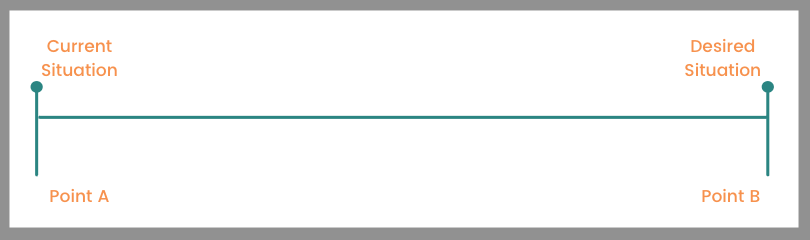
This is critical to know no matter what you are selling.
- Coaching
- Consulting
- Freelance service
You have to know what is the current situation of your customer.
And what they desire.
Examples:
- Website designer: No website –> website
- Video editor: Raw footage of a video –> high quality and professionally edited video
- Dating coach: Being single –> In a relationship
- Branding Consultant: No logo, design or clear message —> clear messaging with professional logo, font and colour matching the brand
These are just some examples of point A to point B for various niches.
What is the point A and point B of your clients?
Map it out and get clear on it.
This is the foundation of your entire messaging, marketing and selling.
This is the transformation you are selling – the result.
Step 3: Break down the stages required to take someone from their current situation to the desired situation
(Some people call this “success path” or “roadmap” or “framework” or the “A to B” – these are all marketing gimmicks to make something appear propriety or special or new – but the concept is all the same)
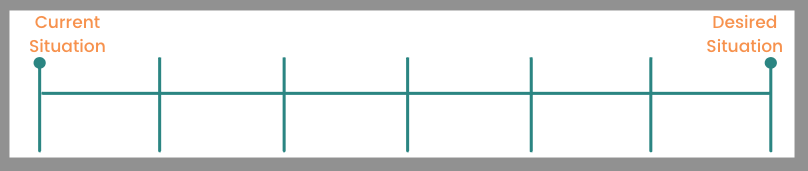
After you figure out point A and point B, time to consider what are the steps you take to help your client through this journey.
This may or may not be clear to you right away.
So if you can’t figure this out quickly, it is probably because you don’t have clarity on this process.
The way to get clarity isn’t to stare at your computer screen, watch endless webinars, or ponder about it.
The process to get clarity on these steps is by actually WORKING WITH CLIENTS 1 ON 1 and helping them achieve point B.
This is the beta phase of your business. (I talk about this in much greater detail in this brochure)
If you haven’t figured out this process with 1:1 clients, you’re probably not ready to do a course or a membership.
So get 1 client who is at point A, and do what is required to get them to point B.
As you do this over and over, you’ll gain clarity on the steps in between and refine this process.
This is the journey that your customer needs to walk in order to get the result they are after.
Step 4: Give each step a name and an exact goal for that step to measure progress in a way that is tangible.
These steps are now your “week #” or “module #”.
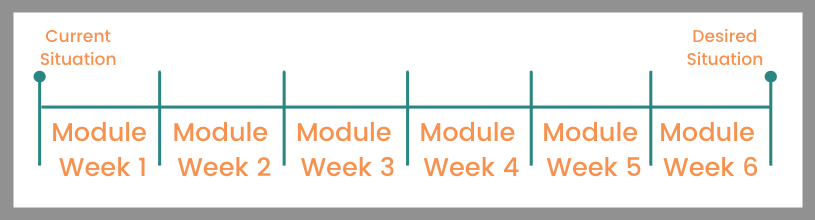
Step 5: Break down each module or week into individual lessons.
These are the step-by-step how-to’s teachings.
Step 6: Create the lessons 1-by-1, here is how you teach these…
(a) State the lesson name and what it will teach
(b) Share a story that illustrates why this is important or how this came about
(c) Share the how to’s or step-by-step instructions or implementation steps
(d) Share examples of how you and/or others implemented these successfully and put this lesson into action
(e) Restate what this lesson taught and give the student the action steps for what’s next
(f) Give a teaser on what is coming next (open loop)
Step 7: Create corresponding assets that go along with each lesson to enhance the learning & implementation experience.
Here is what a lesson can and should include:
- Well scripted & structured video
- Video transcript
- Video close captions
- Audio-only (MP3) version
- Text/summary
- Presentation slides
- Checklist/s or downloadable/s
- Action Item/s
- Call-to-action
People consume content differently and are buying your course to save time and get a shortcut.
Online Course Platform:
There are many online course platforms, too many to cover in this blog but I wanted to give you a rough outline of my back story and familiarity with various tools with the hope that I’ll solve your search for the “right one” right here, right now.
If by the end of this blog, I didn’t convince you to take action – that’s okay.
I invite you to book a free 1:1 consultation with me on Zoom for me to personally help you choose the right one for you according to your circumstances.
If you have a specific platform you want my feedback on, please leave a comment and I promise to give you my honest feedback on it in another blog or a YouTube video just like I did with Searchie or Mastermind.com.
The first course platform I used was in fact, WordPress.
I used various plugins to do it.
I hated it.
It was awful to use, clunky, and just not even worth your time.
Some people will totally disagree with me – that’s cool.
If you want to tinker with technology, go with WordPress.
99% of my clients don’t want to.
If you don’t want to tinker with tech, don’t go with WordPress.
The second platform I used, was Podia.
Podia was wonderful, and to this day I am a customer.
I was quite technically challenged when I first signed up, and Podia solved a huge problem for me.
It was easy to integrate payments through Stripe.
I was able to accept payments online through a credit card for the first time.
It was easy to set up.
It was easy and intuitive to use.
Everything was included and Podia has served me well for a long time.
I sold several courses on it such as the Client Acquisition Course, YouTube SEO, and my $1/day coaching program course (no longer available).
I made approximately 40K with Podia between everything I sold through that platform and had over 1000 customers come through the checkout process.

I even had the pleasure of interviewing Podia CEO, Spencer Fry, on my Podcast.
My Podia website is store.eranbucai.com (a terrible sub-domain, looking back in hindsight, but that’s okay – learning experience).
Since Podia is what I knew, and what I felt comfortable with – I was promoting it a lot for a while.
This was well before I was even building websites for a living.
When I started my freelance business, building websites, it all started with building websites on Shopify.
Shopify is an eCommerce website platform, best designed for physical products.
The back story to starting with Shopify is that I got scammed by an Instagram Influencer who called himself “Income Rebel”, a guy named “Stefan”, who has done an incredible job covering his tracks online… I can’t even find him anymore.
I suspect he blocked me after I asked for a refund.
I paid $3K for 3 Shopify websites, and 1:1 mentorship and training.
The training was a couple of lengthy PDFs, practically no paragraphs, hard to consume and that was it.
The “mentorship” was email communications, with slow replies and short and unhelpful ones at that.
The first website delivered to me was awful.
It was like he set up a template by hiring someone on Fiverr for $5, and handed it over as a “website”.
It was a joke.
I ended up fixing it myself and learning Shopify.
I didn’t bother asking for the 2 other stores as there was no point.
I asked for a refund and was denied.
I believe I was blocked by him, which is possibly why I can’t find him on social media anymore (he has 1.6 million followers, allegedly – although I’m pretty sure the majority were purchased bot followers – something I didn’t even know was possible when I was following him in 2018/2019).
Anyhow – the plus side of it all is I learned to use Shopify.
And I started offering to build Shopify stores for other people and my first 2 website projects were on Shopify.
I then did a WordPress project.
And then I signed up for a white-label funnel software called Simvoly to sell funnels with EranFunnels.
I enjoyed using Simvoly, and I am a customer to this day.
I did the traditional done-for-you projects for the first year, end of 2019 to the end of 2020 and this was good, I made money, served customers and even had 2 website builders working for me to keep up with demand.
Part of the business model was to build their website on my white-label funnel platform, EranFunnels.com, but it is something I decided to change sometime later although I still have dozen or so paying customers on my EranFunnels platform and the website builder is awesome.
For me, selling software as a white-label and providing the tech support was just not sustainable so I stopped selling it as a white label.
In December 2020, I accidentally (no joke) invented a new service of a done-with-you website building where I actually build people’s websites with them on Zoom, i.e. I’m sharing my screen and they are watching me build their website for them so they can learn.
I have yet to find anyone in the online world who does this the way I do it.
Everyone has their own definition of “done-with-you” – that’s cool.
But when I say done-with-you, I literally hop on a Zoom call with you and build your website while sharing my screen so you can watch it get DONE.
I had amazing feedback from people.
I found I can get projects done so much faster when I did it with them on Zoom.
I got faster and faster doing it that way, to the point that by February 2021, I completely phased out of doing the traditional Done-FOR-You projects and only did Done-WITH-You (website building projects on Zoom).
(I still do DFY projects occasionally, did 2 in 2021, did 1 already in 2022, but I don’t do anything under the 4K price tag as an absolute minimum).
By March 2021, I was making 20-30K a month doing it, and I was so unbelievably booked out that I had to figure out the next phase of my business.
That’s when I signed up for Tribe with Stu McLaren and decided on starting a membership.
In April 2021, I opened the doors to my Dot Com Truths membership, which was a Tech Support Membership.
By June 2021, I had over 100+ members in my Dot Com Truths (DCT) tech support membership.
I set up my membership on Kajabi and made 100K in a year with that platform.
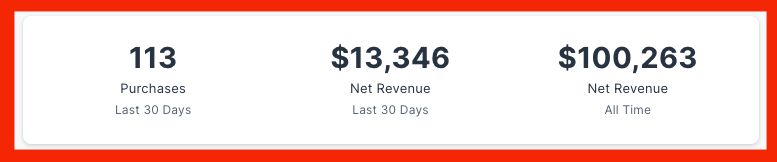
However, despite being with Kajabi for over a year, I wasn’t happy with the course platform aspect.
Limitations on the products, limitations on the lesson creation, and overall it just takes too long to build for my liking.
In the years 2020 and 2021, I have built 100+ websites on Zoom with people.
I used Kartra, Podia, Mighty Networks, Circle, Kajabi, Zenler, Circle, Teachable, MembersVault, and others.
With my extensive experience building websites, I got a pretty clear idea about the distinct differences between the various software tools.
And no matter what you hear about various tools, there are nuances to every single one of them that you simply wouldn’t know unless you truly would have used them as I have.
For example, Kajabi claims to have an affiliate program – they don’t – it sucks. There is no automatic payment so you have to manually track when you pay people out and there’s no way to mark if someone goes paid or not.
Kajabi automations are so good, you can literally customized automations and triggers as good as the advanced marketing automation software like Active Campaign and Keap.
Zenler is the same with their affiliate feature, but worse, you can’t have someone enrol as an affiliate on their own, you have to do it yourself.
On the other hand, Zenler has an amazing feature called “custom blocks” which means you can use the same block in multiple pages with one click – something Kajabi doesn’t have which is crazy to me.
Podia doesn’t let you access subscription payments through PayPal so if you’re running a membership on Podia, you won’t be able to accept subscription or part payments through PayPal – like ever (they wrote an explanation on why here).
Podia’s builder has practically no learning curve and it’s super intuitive and you never have to save your work, it’s autosave (something that doesn’t happen with Kajabi and Zenler).
Zenler Media Library is the best in the market from what I’ve seen, they are way better than Kajabi and Podia with that regard.
I can give you literally pages and pages of comparisons between the various tools but that’s not the purpose of this blog.
If you want me to give you a specific comparison, leave a comment on my YouTube channel and let me know – I’ll record a video on it.
At the time of writing, if you were to put the following tools in front of me (Kajabi, Kartra, Podia, Zenler, Teachable, Thinkific, Systeme, 10X Pro, Vonza, Simplero, etc) and NOT tell me the price of any of them and I simply had to choose between which one is the best one…
i.e. choose based on the quality of the tool regardless of price…
My choice may shock you.
My choice is systeme.io.
I have migrated all my courses from both Podia and Kajabi there.
I migrated my email marketing there, away from Flodesk. (I have seen an increase of 10% on average on my open rates too, maybe it’s the platform, maybe I just got better with my email marketing?)
If you want an online course, there is an 80% chance that I will recommend you use systeme.io.
You can start a free account for it right here.
And you can sign up for an annual plan of $197/year (I have a special affiliate link for that, and when you sign up I have a super cool bonus for you that will save you a ton of time trying to get your website or landing page live… email me to contact@eranbucai.com after you signed up and let me know what email you used so I can check I received credit for you using my affiliate link).
This is 10X cheaper than Kajabi.
And as a Kajabi customer, if you were to give me an option: Kajabi vs systeme, I’ll choose systeme every time.
Kajabi isn’t the best platform – it is simply the best-marketed platform.
Big difference.
I recorded a YouTube video on this comparison which you’re welcome to check out – it’ll give you a real behind the scene look with realistic user-experience comparisons that I haven’t seen on any other comparison video – only someone who is truly familiar with these tools intimately can explain it as I show in the video.
Also, as of March 2022, Kajabi has also finally come out with some great features on adding upsells/downsells and is starting to improve things and come out with better features.
So this isn’t a bash against Kajabi, I still love Kajabi overall.
And I am a happy Kajabi customer and will remain one for a long, long time…
And even though I would go with systeme, don’t think there aren’t little things about it that still annoy me too. (I share those with systeme support and also in my YouTube comparison video).
No software is perfect.
But what’s crazy about systeme, it is the cheapest one of them all!
($27/month or $197/year using a special link I have for you to use).
The second one I would go with is New Zenler, which is $647/year or $67/month (you can create a free account and take it for a test drive).
Zenler continues to come out with great feature additions.
Unlimited courses, unlimited funnels, unlimited pages, 25,000 contacts (plenty!), payment integrations, an app for your products, blog, website, payment integration, you name it – true all in one. (you can watch this group training I did for New Zenler customers)
My biggest complaint about Zenler is their builder being clunky and slow at times.
Reportedly they are working on a builder 2.0, so hopefully, that will improve things.
But it is still, one of the better tools out there.
Pre-selling your course
The last thing I have to mention in this blog is one of the biggest rookie mistakes people make which is creating the course before selling it.
Unless someone like me tells you, “hey, you should sell your course before creating it”, you as a beginner in this space would just have no idea!
I know this for a fact because I didn’t get mentored on this by anyone.
I stumbled across this by accident and it worked.
Later I learned so many of the gurus teach exactly that but I didn’t realize it!
(since I’m so allergic to Guru-BS and marketing hype… I never paid attention – my fault I guess).
Anyhow, here is how I got inspired to do this on my own:
I recall seeing a video on YouTube from Grant Cardone which gave me the inspiration to do this in the course creation space.
The video is called ‘How Fast Are You Monetizing Your Ideas?‘
He said in that video, “… I go from an idea, landing page, buy button, put a price on it, not even a picture of a product.“
That statement and video gave me the idea to pre-sell a course.
When I say “pre-sell a course” I mean to sell the course to your audience BEFORE you actually create the course.
The strategy is super simple and I’ll tell you the story of exactly how I did mine.
At that time I successfully cracked the code of finding customers online through Facebook without paying for advertising.
I had just become debt-free and was making enough to cover my modest living and business expenses through passive income.
And my main strategy to find customers was purely Facebook organic (non-paid) strategies.
I knew it was a super valuable skill and knowledge that people would benefit from.
I thought to myself, “I’m happy to share it with people if they are willing to pay for it but I’m not sharing it unless they pay first.”
I just didn’t care if I didn’t sell anything and kept it all to myself.
So it was almost an intentional decision to not waste any time creating a course because I wanted to see proof that people were willing to pay since I wasn’t dying to share all my secrets anyway on this incredibly valuable skill and strategy.
I sat down with my funnel software (EranFunnels) and wrote the sales page intuitively as I thought to communicate the value of my expertise.
It all flowed nicely, and I had the sales page done in 2 hours.
In fact, I recorded myself creating the entire sales page and you can see it on my YouTube channel.
I hopped on a Facebook live and explained what I am doing and gave my pitch on camera.
My pricing strategy was simple.
I am going to sell this for $500 when the course is done and polished completely.
But if you want to buy it now, I am pre-selling it (i.e. selling it before I record it) and for buying it early you can grab it now for $125 and get lifetime access.
Within the hour I had 2 people buy!
Within the next couple of weeks, I had 16 sales total.
I made a cool $2,000 USD.
For something that I didn’t even create yet – Mind. Blown. ?
This is great for a number of reasons:
- Great for cash flow
- Buy you the time to invest in creating a quality course
- Great to validate your product
- Gives you the first customers who you can beta test your course with and make sure it truly delivers the transformation you promised
- Validate your knowledge and expertise are truly desired
- Covers the costs of the platform you are going to set up your course on
- Increase your confidence that you truly have someone valuable!
You should absolutely pre-sell your course!
Once you pre-sell the course, now what?
NOW you create the course.
So back to my story.
That weekend after my first sales, I recorded 10 or so videos for the course and gave it to these buyers.
I created a questionnaire under each video to collect feedback and a final course feedback.
I had the majority go through the course and give me feedback.
I collected the feedback and recorded the entire course in greater details and it ended up being a 70 video course.
This is my complete “Client Acquisition Course: How to Find Customers on Facebook Without Paying for Advertising”.
This course was used as a bonus for getting membership sign-ups and as a bonus for other affiliate offers.
It has been a fantastic asset that helps me make 10s of 1000s of dollars.
And it all started because I first VALIDATED THE PRODUCT by PRE-SELLING IT.
Since that time, I took additional feedback that the course is great but too long.
So I created the same course, but I condensed it into an under 2-hour course so someone can literally learn everything they need to know in under 2 hours and get going with implementation.
That’s the value of pre-selling, launching, getting feedback, tweaking your product, re-launching, and growing your cash flow and improving the quality of your product based on customer feedback so you truly have a great product that delivers a transformation to your clients.
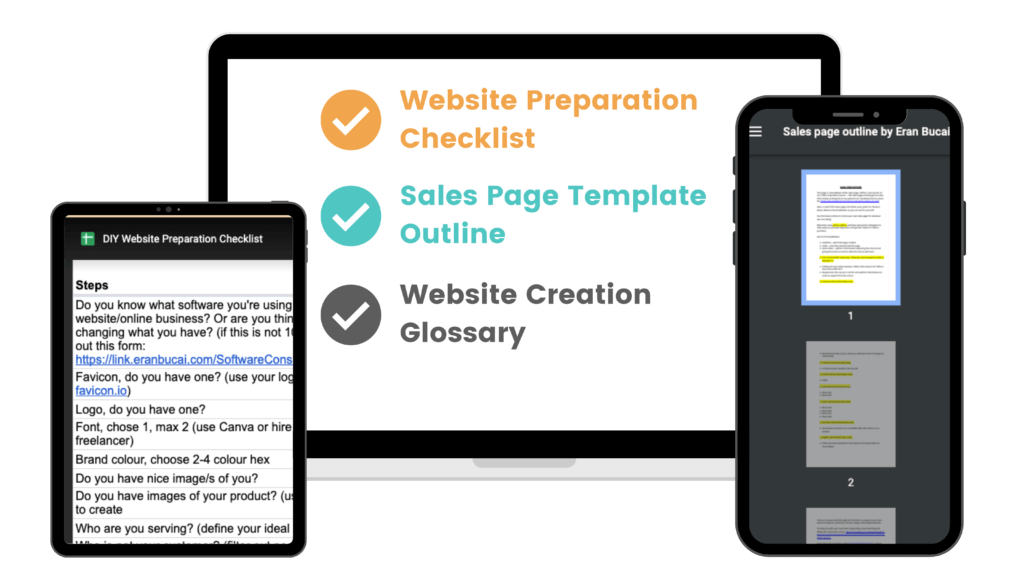
I have taken that sales page and created a PDF template called “sales page template” which I turned into a lead magnet (a free gift you give people in exchange for their email address).
This lead magnet has given me 100s new email subscribers (I’m being modest, it’s probably well over 1000 email subscribers at the time of writing).
You can grab this sales page template along with other goodies by visiting websitediycourse.com.
Templates:
I wanted to thank you for reading this blog.
Your time is valuable and I hope that I added value to your life with this blog.
As a small thank you, here are a couple of templates you can use for free (no email address required) to map out your course.
If you want to work with me more in-depth, learn more about my membership.
I have even more templates for your course waitlist, success path, website templates, email marketing templates, and lots of other super helpful resources.
Sharing is caring
If you know anyone who might benefit from this blog, I would appreciate it if you share it with them.
Leave a comment here on this blog or even better, leave a comment on my YouTube video to let me know any feedback on this blog.
If you or anyone you know needs help choosing a course platform, feel free to connect with me on this page.
Thanks so much!
Looking forward to hearing from you!
Eran Bucai